

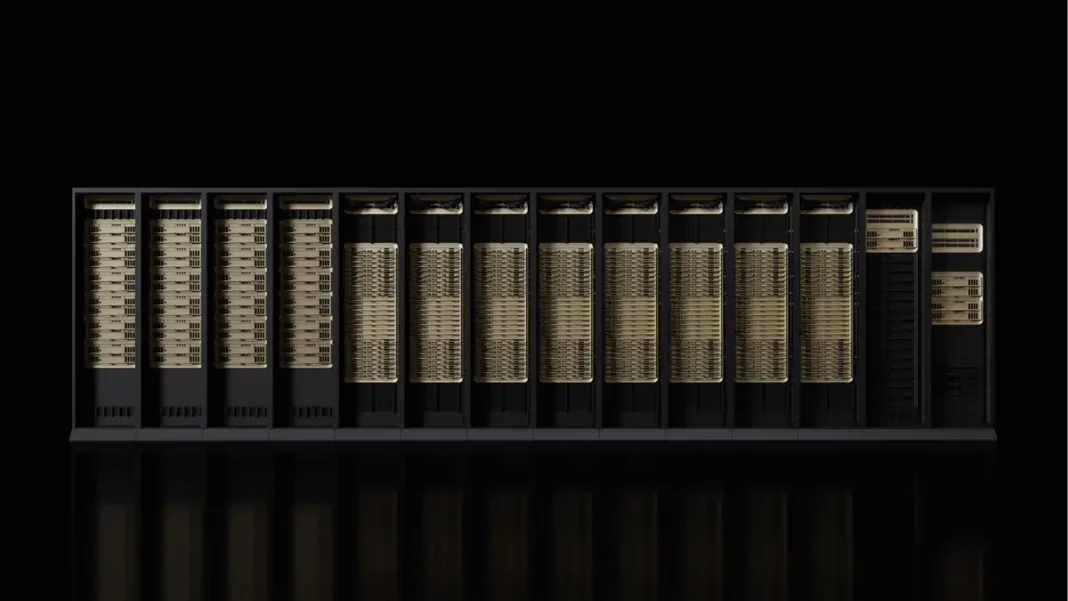
NVIDIA announced its next-generation Rubin platform at CES 2026, marking a major leap in AI computing infrastructure. The six-chip architecture delivers up to 3.5x faster training performance and 10x lower inference costs compared to Blackwell, with production already underway and shipments beginning in the second half of 2026. CEO Jensen Huang positioned Rubin as purpose-built for agentic AI, complex reasoning systems, and mixture-of-experts (MoE) models that are driving the next wave of artificial intelligence.
What’s New in the Rubin Platform
The Rubin platform comprises six integrated chips working as a unified AI supercomputer. At its core sits the Rubin GPU built on TSMC’s 3nm process with 336 billion transistors 1.6x more than Blackwell. The chip pairs with up to 288GB of HBM4 memory delivering 22 TB/second bandwidth, a 2.8x improvement over Blackwell’s HBM3e.
The complete six-chip lineup includes:
- Rubin GPU – 5x AI training compute power vs. Blackwell
- Vera CPU – Designed for agentic reasoning tasks
- NVLink 6th generation – Reduces cluster communication delays
- ConnectX-9 NIC and BlueField DPU – Enhanced networking
- Spectrum-X10 2.7 CPO – Improved Ethernet switching
NVIDIA confirmed all six chips have passed critical production tests. Major cloud providers including Amazon AWS, Google Cloud, Microsoft Azure, and Oracle Cloud will deploy Rubin systems first, starting in H2 2026.
Performance Gains Over Blackwell
Rubin delivers substantial efficiency improvements that directly address AI infrastructure costs. Training performance jumps 3.5x while inference speeds increase up to 5x compared to Blackwell. The platform reaches 50 petaflops peak performance and offers 8x better inference computing power per watt.
For mixture-of-experts models where multiple specialized AI systems handle different query types Rubin cuts GPU requirements by 75%. A single DGX Vera Rubin NVL72 rack contains 72 GPUs and 36 CPUs with 20.7TB total HBM4 memory. Eight-rack SuperPOD configurations scale to 576 GPUs delivering 28.8 exaflops of NVFP4 precision compute.
Token inference costs drop by up to 10x versus Blackwell, addressing one of the biggest operational expenses for AI companies. This cost reduction stems from both architectural efficiency and the HBM4 memory subsystem’s improved bandwidth.

Why the Rubin Platform Matters
Huang stated the timing aligns with “skyrocketing” demand for AI computing across training and inference workloads. The annual release cadence positions NVIDIA to capture enterprise and cloud spending projected to reach $3-4 trillion over five years. Rubin’s efficiency gains directly impact data center power consumption and operating costs, critical as AI infrastructure strains global electricity grids.
The platform’s focus on agentic AI systems that plan, maintain context, and operate autonomously reflects where enterprise AI adoption is heading. Third-generation confidential computing support makes Rubin NVIDIA’s first rack-scale trusted computing platform, addressing security concerns for sensitive workloads.
Lawrence Berkeley National Laboratory confirmed Rubin will power the upcoming Doudna supercomputer system. This academic deployment validates the platform’s capability for scientific computing beyond commercial AI applications.
Rubin vs. Blackwell Quick Comparison
| Specification | Blackwell | Rubin | Improvement |
|---|---|---|---|
| Process Node | 4nm | 3nm | Smaller, more efficient |
| Transistors | 208B | 336B | 1.6x |
| Memory | 192GB HBM3e | 288GB HBM4 | 1.5x capacity |
| Bandwidth | 8 TB/s | 22 TB/s | 2.8x |
| Training Perf | Baseline | 3.5x faster | 3.5x |
| Inference Perf | Baseline | 5x faster | 5x |
| Power Efficiency | Baseline | 8x per watt | 8x |
| Availability | Shipping now | H2 2026 | 6 months |
What’s Next for AI Infrastructure
Cloud providers are preparing data center deployments for late 2026. NVIDIA has not disclosed per-chip pricing, though enterprise DGX system costs typically run six to seven figures based on configuration. Organizations planning AI infrastructure upgrades face a decision: deploy Blackwell now or wait six months for Rubin’s efficiency gains.
The platform’s 8x power efficiency improvement may influence data center design requirements and cooling infrastructure. NVIDIA’s continued annual architecture cadence suggests a successor platform is already in development, maintaining competitive pressure on AMD, Intel, and emerging AI chip startups.
Specification details on power consumption per GPU remain undisclosed, though rack-level power densities are expected to exceed 150 kW requiring liquid cooling systems.
Featured Snippet Boxes
What is the NVIDIA Rubin platform?
The Rubin platform is NVIDIA’s next-generation AI computing architecture featuring six integrated chips Rubin GPU, Vera CPU, NVLink 6, ConnectX-9 NIC, BlueField DPU, and Spectrum-X10 Ethernet switch. Built on 3nm process technology, it delivers 3.5x faster training and 5x faster inference versus Blackwell.
When will NVIDIA Rubin be available?
Rubin entered full production in January 2026 and will ship to cloud providers starting in the second half of 2026. Amazon AWS, Google Cloud, Microsoft Azure, and Oracle Cloud are confirmed early deployment partners.
How much faster is Rubin than Blackwell?
Rubin provides 3.5x better training performance, 5x faster inference, and 8x better power efficiency per watt compared to Blackwell. For mixture-of-experts models, Rubin requires 75% fewer GPUs while reducing inference token costs by up to 10x.
What are the Rubin GPU specifications?
The Rubin GPU contains 336 billion transistors on dual 3nm dies with up to 288GB HBM4 memory and 22 TB/second bandwidth. Peak performance reaches 50 petaflops, and a single NVL72 rack includes 72 GPUs with 20.7TB total HBM4 memory.

