

Summary: Meta announced plans to achieve water-positive status by 2030, meaning its data centers will restore more water to local watersheds than they consume. The strategy relies on dry cooling technology that uses zero water for most of the year, closed-loop liquid cooling systems, and watershed restoration projects. Meta’s Beaver Dam facility in Wisconsin will restore 100% of consumed water and includes 570 acres of wetland restoration. This marks a significant industry shift as AI workloads drive water consumption up to 2.4 gallons per kWh in traditional data centers.
Meta announced a comprehensive water stewardship initiative in December 2025, committing to become water positive by 2030, a target that requires restoring more water to local watersheds than its data centers consume. This strategy represents a fundamental shift from water efficiency to active watershed restoration, addressing mounting concerns about data center water consumption as AI workloads expand.
The announcement comes as data centers face increased scrutiny over resource usage, with traditional facilities consuming 0.26 to 2.4 gallons of water per kWh for cooling alone. Meta’s approach combines three key pillars: minimizing on-site water use through dry cooling technology, maintaining transparent water data reporting, and funding restoration projects that exceed total consumption.
What Does Water Positive Actually Mean?
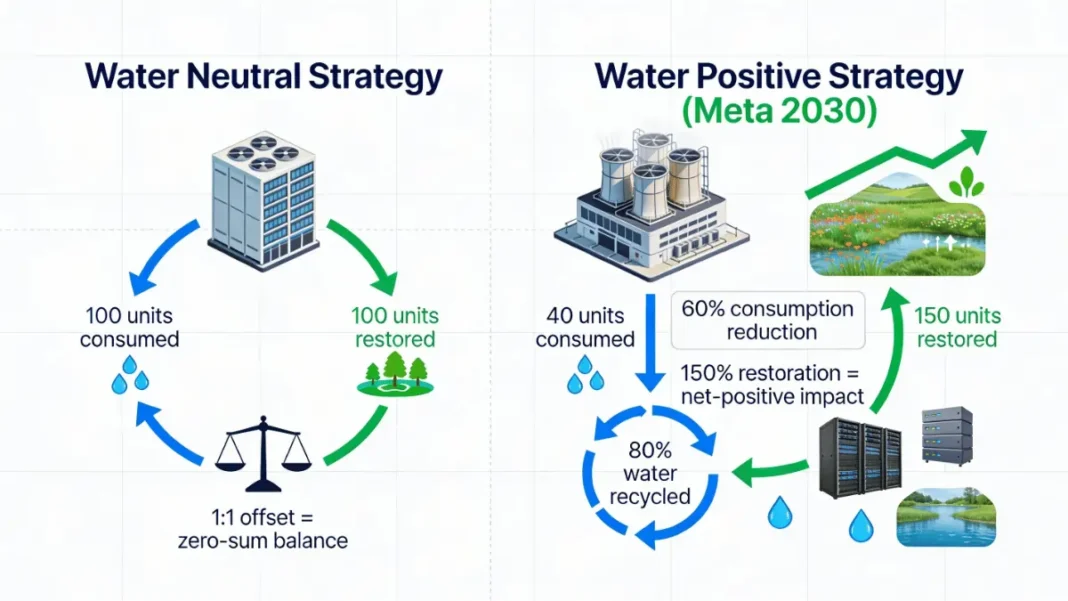
Water positive means restoring more water to local watersheds than a facility consumes. Unlike water neutral strategies that offset usage one-to-one, water positive operations typically reduce consumption by 60%, recycle 80% of processed water, and fund restoration projects returning 150% of residual water use.
The Difference Between Water Neutral and Water Positive
Traditional water efficiency focuses on reducing consumption without addressing net impact on watersheds. Water neutral strategies offset consumption through equivalent restoration, creating a zero-sum balance. Water positive strategies go further by implementing closed-loop systems that minimize freshwater withdrawal, dramatically reducing baseline consumption, and investing in restoration projects that exceed the remaining footprint.
This distinction matters because water scarcity affects 40% of the global population, and data centers in water-stressed regions face regulatory pressure and community opposition that can block expansion projects. Meta’s commitment positions water management as a competitive advantage rather than just a compliance requirement.
- Eliminates or drastically reduces freshwater consumption through dry and closed-loop cooling
- Improves community relationships and reduces regulatory risk in water-stressed regions
- Supports high-density AI workloads with stable chip-level temperature control
- Delivers measurable environmental benefits through watershed restoration
- Can save over 125 million liters annually per data center
- Reduces dependence on municipal water infrastructure
- Positions organizations ahead of expected future water regulations
- Higher initial capital costs compared to traditional evaporative cooling
- Dry cooling performance degrades in hot climates, limiting deployment flexibility
- Requires more sophisticated technical expertise for operation and maintenance
- Closed-loop systems not yet as thermally efficient as direct evaporative cooling
- Potential concerns about specialized coolants introducing PFAS chemicals
- Restoration projects require long-term partnerships and monitoring to verify impact
- Technology maturity varies across different cooling approaches
Why Data Centers Need So Much Water
Understanding Cooling Requirements
Data centers generate massive heat from thousands of servers running 24/7. Traditional cooling systems use water-based evaporative cooling, where water absorbs heat and evaporates into the atmosphere. This process is thermally efficient because the latent heat of evaporation provides substantial cooling capacity.
Evaporative cooling systems continuously require makeup water to replace what evaporates. Wet cooling towers consume significantly more water than alternative methods but deliver superior cooling efficiency, especially in humid climates. The national weighted average for data center cooling ranges from 1 to 9 liters per kWh of server energy, depending on weather conditions and operational settings.
The AI Factor: Rising Water Demands
AI workloads intensify cooling requirements because high-density GPU clusters generate more heat than traditional server configurations. This creates a dilemma: using more water allows data centers to avoid running electric cooling systems, while using more electricity lessens the water footprint but increases power bills and greenhouse gas emissions.
Cooling needs peak during summer months when ambient temperatures rise, causing data centers to consume more water or electricity depending on their cooling strategy. Some facilities have reported water pressure and quality issues in surrounding communities after hyperscale data center deployment.

Meta’s Three-Pillar Water Stewardship Approach
Pillar 1: Minimizing On-Site Water Use
Meta prioritizes water efficiency through increasingly water-efficient facility design features. The company implements water-budgeting and flow meter audits to track and reduce consumption across its data center portfolio. This includes deploying dry cooling systems that require zero water for cooling operations most of the year.
The El Paso facility uses a closed-loop liquid cooling system designed to operate without water intake under normal conditions, aligning with the 2030 water-positive goal. This technology recycles water within a closed network, dissipating heat efficiently without additional water intake once initial setup is complete.
Pillar 2: Transparency Through Data
Meta publishes water consumption data and tracks Water Usage Effectiveness (WUE) metrics to maintain accountability. The company leverages digital twin models virtual representations of cooling systems to generate accurate estimates of short- and long-term water usage under current and projected operating conditions.
These digital twins enable data-driven approaches to capacity planning, compliance monitoring, and water efficiency project prioritization. This level of transparency helps Meta identify optimization opportunities and demonstrate progress toward water-positive targets.
Pillar 3: Watershed Restoration Projects
Since 2017, Meta has invested in over 30 water restoration projects across nine watersheds. These projects address shared water challenges, bolster local water supplies, and help restore habitats and wildlife. The restoration work goes beyond simple offsets by improving watershed health through wetland creation, prairie restoration, and infrastructure improvements that benefit entire communities.
Meta partners with organizations like Ducks Unlimited and local conservation groups to implement projects that provide flood storage, filter nutrients before they enter waterways, create wildlife viewing opportunities, and offer recreational spaces. This collaborative approach ensures restoration projects deliver multiple benefits beyond water quantity.
Dry Cooling vs. Evaporative Cooling: The Technical Shift
| Cooling Method | Water Consumption | Energy Efficiency | Cooling Capacity | Climate Suitability | Initial Cost |
|---|---|---|---|---|---|
| Direct Evaporative | High (continuous makeup) | Excellent (25% of traditional AC) | Up to 30°F reduction | Best in dry climates | Low |
| Dry Cooling | Zero operational water | Lower than evaporative | Limited by ambient temp | Works in cooler climates | Medium |
| Closed-Loop Liquid | Near-zero (only replacement) | High (80% WUE improvement) | Excellent for high-density AI | All climates | High |
| Two-Stage Evaporative | 30% less than direct | 60-75% less than conventional AC | Up to 44.6°F reduction | Moderate climates | Higher |
How Dry Cooling Works
Dry cooling systems use air-to-air heat exchangers instead of water evaporation. Heat transfers directly from the working fluid to ambient air through radiators or finned-tube heat exchangers. This eliminates water consumption during operation but requires larger surface areas and more fan energy compared to evaporative systems.
Performance depends heavily on ambient air temperature dry cooling becomes less effective during hot weather when cooling demand peaks. This limits deployment to cooler climates or requires hybrid systems that can switch to alternative cooling methods during temperature spikes.
Closed-Loop Liquid Cooling Systems
Closed-loop systems circulate water or specialized coolants through a sealed network. Once filled, the system operates independently, dissipating heat through external radiators or heat exchangers without requiring fresh water intake. Microsoft reports that this approach delivers an 80% improvement in WUE compared to older data centers.
These systems maintain temperature stability at the chip level, making them ideal for high-density AI computing that generates concentrated heat loads. The technology is particularly effective for direct-to-chip cooling, where coolant flows through cold plates attached directly to processors. Companies including Microsoft, Carrier, and Vertiv are accelerating investment in direct-to-chip cooling solutions.
Performance Trade-offs
Closed-loop and dry cooling systems are not yet as thermally efficient as direct evaporative cooling. The trade-off involves accepting slightly higher operating temperatures or increased fan energy in exchange for eliminating water consumption. For AI workloads that can tolerate wider temperature ranges, this trade-off becomes acceptable.
Advanced cooling technologies can save 125 million liters per data center annually while reducing WUE to near-zero in new builds. However, implementation requires higher initial capital investment and more sophisticated maintenance compared to traditional evaporative systems.
Meta’s Beaver Dam Data Center: A Case Study
Meta’s $1 billion Beaver Dam facility in Wisconsin demonstrates the water-positive strategy in practice. The campus spans over 700,000 square feet with operational buildings targeting LEED Gold certification. The project showcases how sustainability commitments integrate with large-scale infrastructure development.
100% Water Restoration Commitment
The Beaver Dam data center will restore 100% of consumed water to local watersheds through targeted restoration projects. The facility uses dry cooling technology, meaning it will have no water demands for cooling once operational. This eliminates the largest water consumption category for data centers.
Meta is underwriting nearly $200 million in energy infrastructure investments including network upgrades, utility substations, and transmission lines to support the facility. The company will match 100% of the site’s electricity use with clean and renewable energy.
570 Acres of Wetland and Prairie Restoration
In partnership with Ducks Unlimited and local conservation organizations, the project includes restoring 570 acres of biodiverse wetland and prairie surrounding the data centers. Of this total, 175 acres of greenspace will be deeded to Ducks Unlimited and partners for ongoing conservation work.
The restored habitat will provide flood storage, filter nutrients before they enter the watershed, create opportunities for wildlife viewing particularly migratory birds and pollinators and offer recreational spaces for visitors. This approach transforms data center development from pure infrastructure investment into comprehensive watershed improvement.
Digital Twin Technology for Water Management
Real-Time Modeling and Predictions
Meta uses digital twin models virtual replicas of physical cooling systems to simulate water usage under various operating conditions. These models generate accurate short-term and long-term consumption estimates based on weather forecasts, workload projections, and equipment performance data.
The technology enables proactive capacity planning rather than reactive adjustments. Operators can test efficiency improvements virtually before implementing physical changes, reducing trial-and-error optimization cycles. Digital twins also support compliance monitoring by tracking actual consumption against permitted limits in real time.
This data-driven approach helps Meta prioritize water efficiency projects based on measurable impact rather than intuition. The models improve over time as they incorporate actual performance data, creating increasingly accurate predictions.
Comparing Tech Giants’ Water Strategies
Microsoft committed to becoming water positive by 2030 and has deployed zero-water cooling systems at pilot sites in Phoenix and Mt. Pleasant. All Microsoft builds from August 2024 onward use zero-water designs. The company reduced its WUE from 0.49 L/kWh in 2021 to 0.30 L/kWh by 2024.
Amazon announced water-positive goals but faces criticism for the complexity of tracking water restoration versus direct consumption. The company’s data centers account for a small percentage of overall U.S. freshwater consumption, though regional impacts vary significantly.
Google reported its thirstiest Iowa data center consumed approximately 2.7 million gallons per day in 2024, with most facilities using substantially less. The company is exploring closed-loop systems but has not announced company-wide water-positive targets.
Meta’s approach stands out for integrating dry cooling, closed-loop systems, and substantial watershed restoration commitments into a unified strategy with clear 2030 targets. The Beaver Dam project’s 570-acre restoration component represents one of the industry’s most ambitious habitat restoration efforts tied to a single facility.
Implementation Challenges and Limitations
Climate and Location Constraints
Dry cooling systems perform best in cooler climates where ambient air temperatures remain moderate year-round. Deploying these systems in hot, arid regions requires larger heat exchanger surfaces and increased fan energy, reducing overall efficiency advantages.
Meta’s strategy acknowledges these constraints by tailoring cooling approaches to specific site conditions. The company leverages digital twin modeling to evaluate cooling options during site selection, ensuring chosen technologies align with local climate patterns.
Cost Considerations
Closed-loop liquid cooling and dry cooling systems require higher initial capital investment than traditional evaporative towers. Two-stage evaporative systems, which offer partial water savings, cost more than single-stage designs and demand more sophisticated maintenance.
The economic case for water-positive strategies improves in water-stressed regions where access to freshwater is expensive, regulated, or politically contentious. Facilities that invest in advanced cooling position themselves ahead of potential future regulations while avoiding community opposition that can delay or block expansion projects.
Technology Maturity
Some advanced cooling technologies involve specialized coolants that raise concerns about introducing per- and polyfluoroalkyl substances (PFAS) forever chemicals into water systems. This has made major tech companies cautious about large-scale deployment until safer alternatives are validated.
Closed-loop systems require ongoing monitoring to prevent leaks and maintain fluid quality. While the technology is proven, it demands more technical expertise than traditional cooling towers, potentially increasing operational complexity.
What This Means for the Industry
Meta’s water-positive commitment signals a broader industry shift from efficiency metrics to net-positive environmental impact. As AI computing demands grow, data center operators face a choice: invest proactively in sustainable cooling or risk regulatory restrictions and community opposition.
The technology strategy liquid and dry cooling directly addresses environmental threats while enabling future AI workload growth. Companies that execute this transition efficiently will gain competitive advantages in site selection, regulatory approval, and public perception.
Water scarcity creates genuine business risk: approximately 40% of the global population experiences water stress, and data centers operating in these regions may face usage caps, expansion denials, or mandatory curtailments during droughts. Water-positive strategies transform this risk into opportunity by positioning facilities as community partners that improve local water security.
The Open Compute Project and similar initiatives are standardizing water-efficient hardware designs, making it easier for operators of all sizes to adopt these technologies. Meta’s leadership in open hardware standards could accelerate industry-wide adoption of water-positive practices.
Meta Water Stewardship Program Specifications
Target Completion: 2030
Current Status: Over 30 restoration projects completed across 9 watersheds since 2017
Cooling Technologies Deployed:
- Dry cooling (zero operational water)
- Closed-loop liquid cooling (near-zero water)
- Digital twin modeling for optimization
Beaver Dam Data Center (Wisconsin):
- Investment: $1 billion
- Size: 700,000+ square feet
- Certification Target: LEED Gold
- Water Restoration: 100% of consumption
- Habitat Restoration: 570 acres wetland and prairie
- Conservation Transfer: 175 acres to Ducks Unlimited
- Energy Infrastructure: $200 million investment
- Renewable Energy: 100% matched
Industry Comparison:
- Microsoft WUE: 0.49 L/kWh (2021) → 0.30 L/kWh (2024)
- Typical Data Center: 1-9 liters per kWh cooling water
- Closed-Loop Savings: 125 million liters per facility annually
- Google Iowa Facility: 2.7 million gallons per day (peak consumption)
Frequently Asked Questions (FAQs)
What does water positive mean for data centers?
Water positive means a data center restores more water to local watersheds than it consumes through operations. This typically involves reducing direct consumption by 60%, recycling 80% of processed water through closed-loop systems, and funding restoration projects that return 150% of residual water use to local sources.
How much water do AI data centers typically use?
Traditional data centers consume 0.26 to 2.4 gallons (1-9 liters) of water per kWh for cooling, depending on weather conditions and operational settings. AI workloads can increase this consumption because high-density GPU clusters generate more concentrated heat than traditional server configurations.
What is dry cooling and how does it work in data centers?
Dry cooling uses air-to-air heat exchangers instead of water evaporation to dissipate heat. Heat transfers from the working fluid to ambient air through radiators or finned-tube exchangers, eliminating water consumption during operation. Meta’s Beaver Dam facility will use dry cooling, requiring zero water for cooling once operational.
How do closed-loop cooling systems differ from traditional cooling?
Closed-loop systems circulate water or specialized coolants through a sealed network. Once filled, the system operates independently without requiring fresh water intake, dissipating heat through external radiators. Microsoft reports 80% WUE improvement compared to older data centers using this technology.
What are water restoration projects in the context of data centers?
Water restoration projects improve watershed health by creating wetlands, restoring riparian habitats, upgrading water infrastructure, or implementing conservation practices that increase water availability. Meta has invested in over 30 restoration projects across nine watersheds since 2017, addressing shared water challenges and bolstering local water supplies.
Why is Meta targeting 2030 for water positive status?
Meta announced its water positive goal in 2021 as part of broader sustainability commitments. The 2030 target aligns with industry timelines for deploying advanced cooling technologies at scale and completing watershed restoration projects that require years to deliver full environmental benefits.
Can dry cooling work in all climates?
Dry cooling performs best in cooler climates where ambient air temperatures remain moderate year-round. In hot climates, dry cooling requires larger heat exchanger surfaces and more fan energy, reducing efficiency advantages. Facilities in warmer regions often use hybrid systems that combine multiple cooling approaches.
What is the difference between water neutral and water positive?
Water neutral strategies offset consumption one-to-one through restoration, creating a zero-sum balance. Water positive strategies go further by dramatically reducing baseline consumption and investing in restoration projects that exceed the remaining footprint, resulting in net-positive watershed impact.

Featured Snippet Boxes
Water Positive Definition
Water positive means restoring more water to local watersheds than a facility consumes. Unlike water neutral strategies that offset usage one-to-one, water positive operations typically reduce consumption by 60%, recycle 80% of processed water, and fund restoration projects returning 150% of residual water use.
Data Center Water Usage
Data centers consume 0.26 to 2.4 gallons of water per kWh for cooling, depending on weather and operational settings. AI workloads increase this consumption because high-density GPU clusters generate more heat than traditional servers.
Dry Cooling Explained
Dry cooling uses air-to-air heat exchangers to dissipate heat without water evaporation. Meta’s Beaver Dam facility will use dry cooling, requiring zero water for cooling operations once active.
Closed-Loop Systems
Closed-loop cooling systems circulate water through a sealed network, operating independently without fresh water intake after initial filling. Microsoft reports 80% WUE improvement compared to traditional data centers.
Meta’s 2030 Target
Meta committed to becoming water positive by 2030, meaning its data centers will restore more water than they consume through dry cooling, closed-loop systems, and restoration projects.
Industry Impact
Water-positive strategies transform business risk into opportunity by positioning data centers as community partners that improve local water security, particularly important as 40% of the global population experiences water stress.

